For Tinnitus Week, we’re exploring a common and frustrating question: “My audiologist said my hearing is perfect, so why do I have this ringing in my ears?” The cornerstone of tinnitusclinic.ie practice, the QNAS process, has the crucial fact that tinnitus is a symptom of
an underlying auditory weakness. If this is so, how is it possible to apparently have excellent hearing and tinnitus?
It’s a confusing situation. You go for a hearing test, expecting to find a cause for your tinnitus, but are told your hearing is within normal limits. If your hearing is fine, where is the phantom sound coming from? The answer lies in what a standard hearing test doesn’t measure.
The Limits of a “Normal” Hearing Test
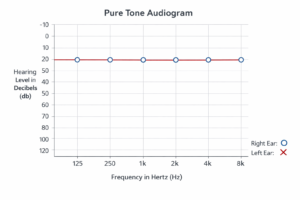
A standard hearing test, known as pure-tone audiometry, typically tests frequencies from 125 Hz up to 8,000 Hz (8 kHz). These are the most important frequencies for understanding speech. If you can hear these tones at a low volume (around 0-20 decibels), your hearing is
considered ‘normal.’
Below is an example of what an audiogram showing excellent hearing looks like. The red circles (right ear) and blue crosses (left ear) are all near the 0 dB line, indicating no hearing loss in the tested range.
The “Hidden” Hearing Loss
The problem is that human hearing extends well beyond 8 kHz, up to roughly 20,000 Hz (20 kHz) for a young, healthy ear. These higher frequencies are often the first to be damaged by noise exposure or aging, but because they aren’t routinely tested, this damage can remain
“hidden.”
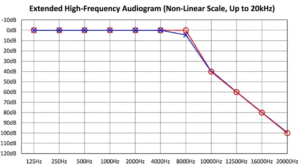
An extended high-frequency audiogram can reveal this missing information. Below is an audiogram for the same person as above, but this time testing up to 20 kHz.

As you can see, while hearing is excellent up to 8 kHz, there is a severe and sharp decline in hearing ability for frequencies above that point. This person has significant hearing loss, but a standard test would miss it entirely.
Where Is This Damage Located?
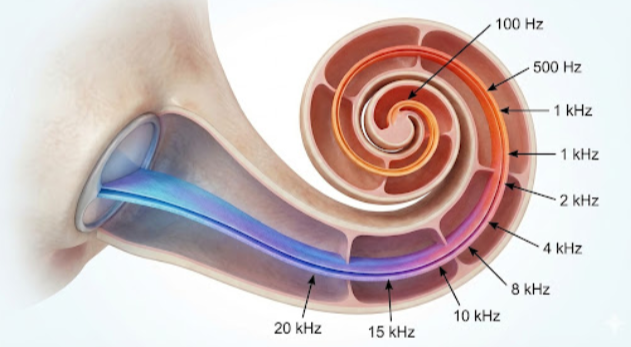
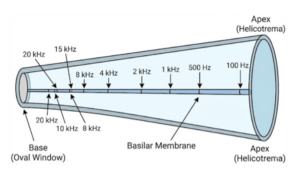
This high-frequency hearing loss occurs in a specific part of your inner ear, the cochlea. The cochlea is lined with hair cells that detect sound, and they are arranged by frequency, like keys on a piano. High-frequency sounds are detected at the very base of the cochlea, near where sound enters. This area is the most vulnerable to damage. The images below show this arrangement.


When the hair cells in this high-frequency region are damaged, they can no longer send signals to the brain. In response to this lack of input, the brain can become hyperactive, creating the phantom sound we know as tinnitus. So, even if your standard hearing test is ‘perfect’; you could still have significant damage in your inner ear that is causing your tinnitus.
In Part 2 of this series, we’ll discuss Cochlear Synaptopathy, another form of hearing loss which is not detected by an ordinary Pure Tone Audiometry test.
* all diagrams are representative and for indicative purposes only. They do not purport to be anatomically or scientifically accurate.