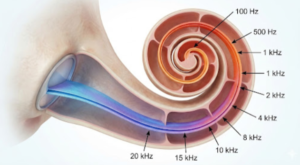
Welcome back to our series for Tinnitus Week. In Part 1, we explored how hearing loss above the standard 8 kHz range can trigger tinnitus. Now, we dive deeper into another subtle form of auditory damage that an ordinary hearing test misses: Cochlear Synaptopathy.
The cornerstone of the QNAS process is the crucial fact that tinnitus is a symptom of an underlying auditory weakness. If your standard hearing test is “perfect,” the weakness may not be in the ear’s ability to hear, but in the “wiring” that carries the sound to the brain.
The Science: The Work of Dr. Stéphane F. Maison
Groundbreaking research by Stéphane F. Maison, PhD, of Harvard Medical School and Mass Eye and Ear, has fundamentally changed our understanding of tinnitus. His work suggests that the degradation of the connection between the cochlea and the brain is at the heart of the issue.
“Our work suggests that a loss of the connection between the ear and the brain is at the root of virtually all cases of subjective tinnitus.” — Stéphane F. Maison, PhD
Dr Maison’s research shows that you can have healthy hair cells (the “piano keys” of the cochlea) yet still experience a profound loss of the nerve fibres that connect them to the brain. This means a standard “beep test” looks normal because the few remaining fibers can still detect a faint tone in a quiet room, even if the overall “bandwidth” is severely compromised.
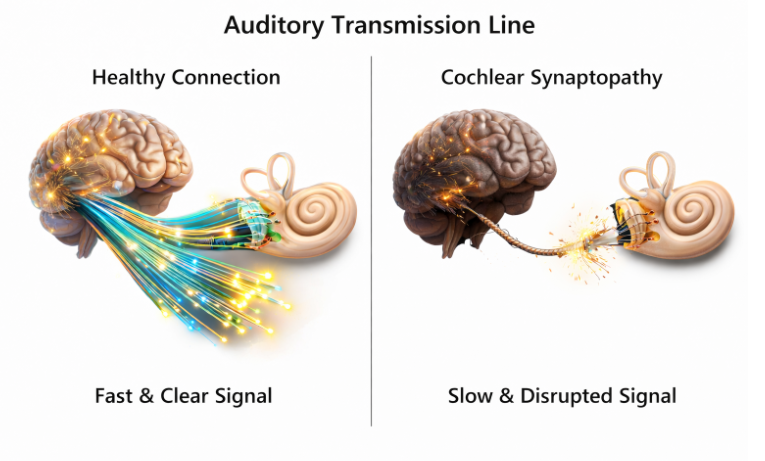
The “Auditory Transmission Line” Analogy
To understand this, think about your internet connection.
- Healthy Hearing (Fibre Broadband): Signals travel from the cochlea to the brain through a dense bundle of healthy nerve fibers. This is like high-speed fibre-optic broadband—fast, clear, and capable of carrying massive amounts of data without interference.
- Cochlear Synaptopathy (Dial-Up Connection): While the cochlea might still be functioning, the “wiring” (synapses) has degraded. This is like trying to run a modern household on an old, frayed dial-up connection. The signal is slow, lossy, and full of “static.”
When the brain receives this weak, “low-bandwidth” signal, it reacts by turning up its internal gain to find the missing data. This neural hyperactivity is what we perceive as the phantom sound of tinnitus.
How Synaptopathic Damage Occurs and Affects You
Synaptopathy is often the result of noise overexposure or aging. A single loud event (like a concert or explosion) or years of moderate noise can “disconnect” these synapses long before the hair cells themselves actually die.
How it feels in the real world:
- The “Cocktail Party” Effect: You can hear people talking, but you can’t understand the words, especially when there is background noise.
- Increased Effort: Listening becomes exhausting because your brain has to work much harder to “fill in the gaps” caused by the poor connection.
- Persistent Tinnitus: Even in total silence, the brain remains in a hyper-active state, searching for the input it lost.
Why the Standard 8 kHz Test is Insufficient
As we’ve seen, relying solely on a standard Pure Tone Audiometry test up to 8 kHz is insufficient for a modern tinnitus investigation. To truly understand the root cause, we must look at three critical areas:
- Standard Audiometry (up to 8 kHz): Necessary for basic speech but misses the full picture.
- Extended High-Frequency Audiometry: To detect “hidden” loss at the base of the cochlea.
- Synaptic Integrity: Assessing how the brain processes sound in complex environments to identify “wiring” issues that the standard test cannot see.
By investigating these three areas, we can move beyond the frustration of “perfect hearing” and develop strategies based on the actual state of your auditory system.
* all diagrams are representative and for indicative purposes only. They do not purport to be anatomically or scientifically accurate.